
Effective coastal resilience and adaptation in practice - Part 2 - Delivery readiness
In this short series of articles, we share our perspective on what effective coastal adaptation and resilience really requires in practice.

Coastal adaptation readiness: A delivery model
Across many coastal communities, studies have been completed, assessments undertaken, and adaptation plans have been developed. Yet a recurring question remains: what happens next?
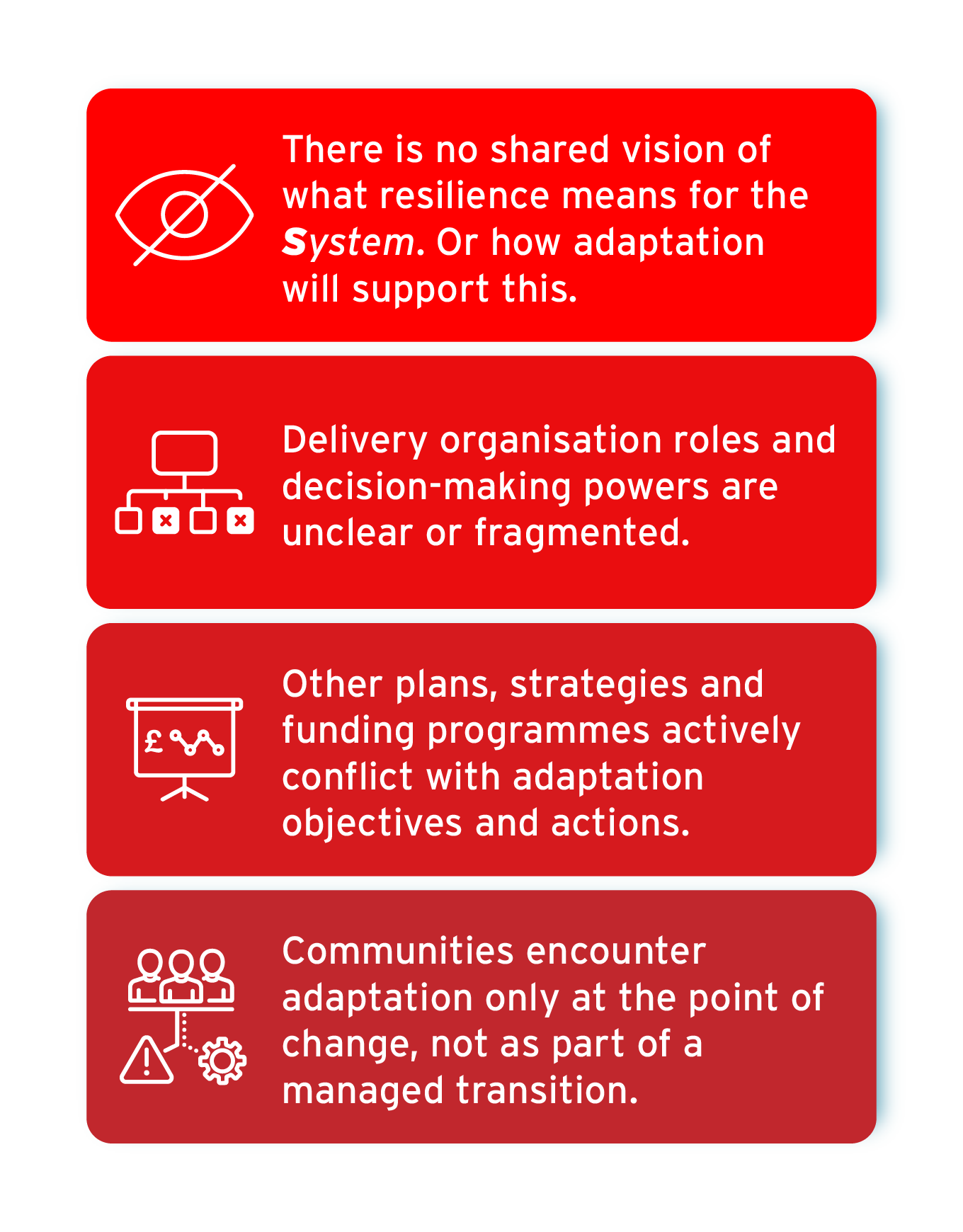
The challenge is no longer identifying risks or recommending actions, but creating the conditions for delivery. How do we translate evidence, recommendations and priority actions into investment and implementation? How can organisations make budgeting decisions that are smarter, more efficient and complementary across programmes and funding streams? And who is responsible and accountable for delivering actions that cut across multiple services, agencies and partners?
Addressing these questions is critical if coastal adaptation is to move from planning into action, and it is the focus of a coastal adaptation readiness approach designed to bridge the gap between strategy and delivery. Read on to find out more.
Why might adaptation stall?
Too often, coastal adaptation initiatives begin by producing an adaptation plan before the conditions needed for delivery are understood, let alone in place. As a result, many coastal authorities now possess well-evidenced plans and strategies that struggle to move into implementation. These issues are not technical; they are governance challenges. Only by addressing them early will organisations be “ready” to adapt.
Our System-of-systems approach to coastal resilience has helped us develop a blueprint for a Coastal Adaptation Delivery Model that addresses these challenges. This model supports the development of a strong governance system to coordinate roles, decisions and investment across the component systems. By acknowledging this upfront, the governance system can set an overarching framework and direction that enables adaptation and transition to be driven through bottom-up, local, co-created delivery. That allows local priorities to shape decisions and outcomes that work for communities, businesses and landowners.
Understanding and improving the ability to deliver in each system
This model addresses these challenges with a deliberate shift of focus upstream from the outset and acknowledges that successful, fundable adaptation depends on investing first in four foundational steps. The steps shown opposite establish the conditions for delivery, promoting a system that is complementary and aligned rather than fragmented and in conflict. However, too often, we move to Step 5 too quickly, giving only a light-touch acknowledgement to 1-4.
While the model is built around fixed concepts - systems thinking, governance, ecosystems and components - it is translatable and can be applied flexibly to reflect the needs, capacities and priorities of any broader System (e.g. organisation, asset portfolio, community, beach system).
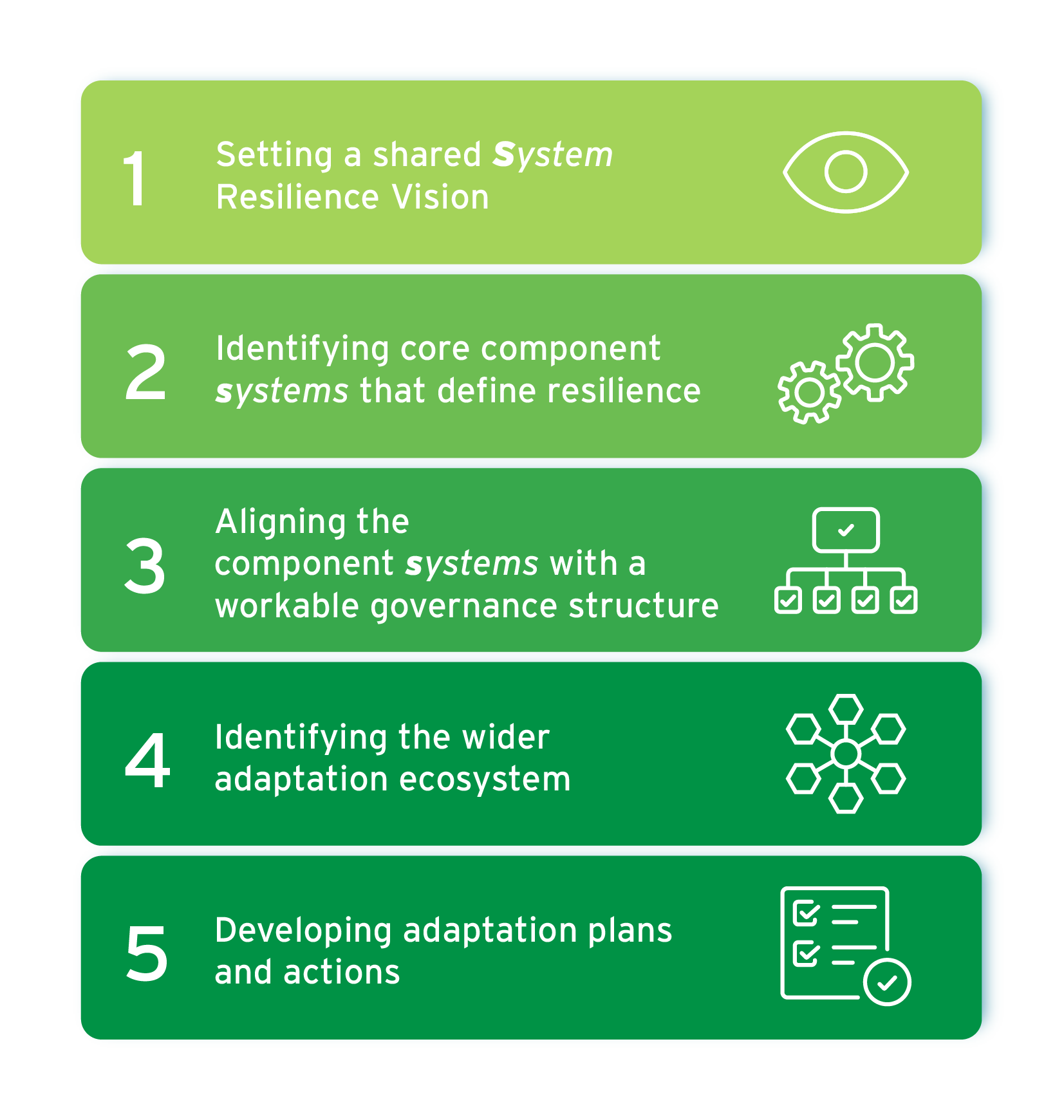
Our Coastal Adaptation Delivery Model
Step 1 – The System resilience vision
The resilience vision sets the long-term direction of travel, defining what communities and organisations are trying to sustain, adapt or transform over time. It establishes a shared understanding of future intent and provides a guiding reference for all subsequent decisions, actions, and investments. Through a systems-led visioning process, we can:
- Define the component systems that together make up coastal System resilience (e.g. environment, infrastructure, communities).
- Through each system, establish a shared understanding of long-term coastal System change and uncertainty.
- Define what improved resilience means in the System context (e.g. safety, place identity, economic function, environmental outcomes).
- Identify acceptable and unacceptable futures.
- Agree on the long-term ambition for an adaptation plan in each system (e.g. sustain, transition, relocate, transform).
The resilience vision is not a list of management policies or intervention options. It is a statement of intent against which adaptation plans, pathways and decisions can be tested. The vision will be refined and strengthened through the adaptation planning process and associated engagement, as understanding improves and delivery pathways take shape.
Without a clear resilience vision, decisions tend to default to short-term risk management; trade-offs are made implicitly rather than transparently; and communities experience adaptation as reactive, unplanned loss (unmanaged transition) rather than as planned, supported change (managed transition).
Focusing on delivery readiness at this stage enables difficult conversations to happen early and constructively.
“We are resilient when everyday life keeps working as conditions change. People are supported, involved and empowered, essential services function, the local economy adjusts, and space is made for natural processes to deliver wider benefits. We do this through planning, so change is delivered incrementally, and shocks do not cascade into lasting loss.“
Step 2 – Identify component systems
Resilience is typically supported by:
- Natural systems – coastlines, habitats.
- Built systems – defences, infrastructure, housing.
- Community systems – health, vulnerability, skills and needs and services.
- Economic systems – livelihoods, local economies, funding opportunities, regeneration priorities.
- Planning systems – spatial planning and land-use policy, development, consenting, placemaking and regeneration frameworks.
- Governance systems – cross-cuts at System level to avoid conflicts, take opportunities, and deliver strategic and local priorities.
While traditional risk management may identify these, too often they are recognised as supporting and potentially independent. Here we make the shift to fully acknowledging them as an integrated part of a single System, whose interaction collectively shapes resilience. Within the framework, these component systems are expressed through a set of resilience themes to support clear and accessible understanding.
For each system, this step:
- Clarifies ownership and accountability.
- Maps statutory duties and decision-making powers.
- Identifies gaps, overlaps and misalignments between teams and organisations.
- Establishes how decisions affecting resilience and adaptation will be coordinated.
- Identifies quantifiable indicators to track condition, change and performance.
Together, this provides a consistent framework for understanding how different parts of the System contribute to resilience and how decisions affecting one resilience theme may influence others. This shared structure is carried forward into adaptation planning, providing a clear basis for aligning actions, investments, and pathways across the System.
Step 3 – Aligning governance
Many adaptation barriers arise because responsibility is assumed rather than agreed. Aligning resilience component-systems with governance can transform adaptation from an aspiration into a reality.
This creates a transparent and defensible position where a governance structure that supports adaptation decisions can be enabled. Crucially, governance alignment must also be with community and local priorities, so decisions are co-created and delivery can be driven locally (bottom-up) within a clear strategic framework (top-down). Aligning component-systems with governance transforms adaptation from an aspirational plan into organisational readiness and delivery.
As a starting point, aligning governance involves identifying who need to be involved in shaping adaptation, and clarifying where decision‑making authority sits and where responsibility is shared.
Governance models are strongly organisational or System-dependent. Our model therefore provides an initial simplified structure that acknowledges governance in three core elements.
- Technical Oversight – Responsible for understanding the risks, impacts, advances in science and technical practicalities of delivering Actions.
- Delivery – Responsible for enabling the delivery of Actions through funding commitments, identification of delivery pathways, influence over budgets, and overall resource planning.
- Awareness – Responsible for managing external relationships and coordinating engagement to support delivery. This includes ensuring partners and communities are involved at the right time, avoiding conflicts, and identifying complementary opportunities.
Step 4 – Mapping the ecosystem
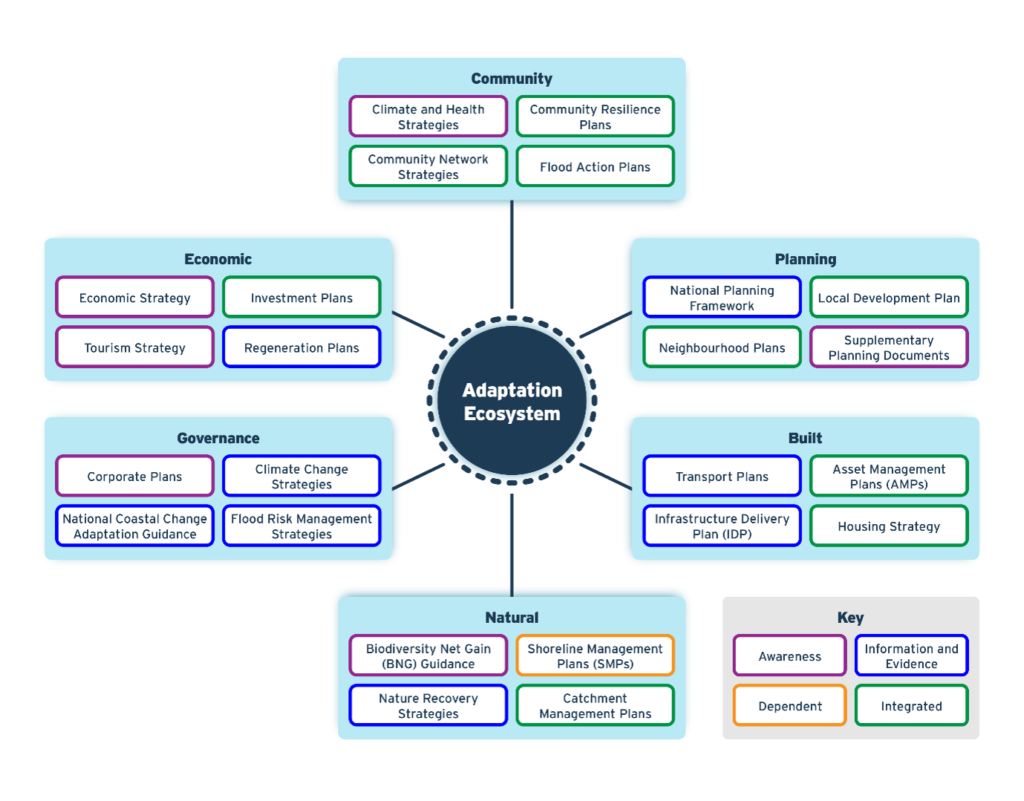
Plans and strategies should be identified to ensure they align with adaptation objectives. Conflicts and misalignments need to be addressed early. Dependencies and the sequencing of actions should be clearly outlined. Everyone must share an understanding of where influence and leverage are found. A ‘typical’ ecosystem may include:
- Spatial, place, community and land-use plans.
- Shoreline and flood risk management plans.
- Infrastructure, regeneration and investment programmes.
- Nature restoration and environmental strategies.
- Housing, health and social resilience plans.
This step explicitly addresses the challenge: complement, not conflict, concept of our approach.
- Do these support adaptation delivery?
- Are objectives aligned with each other?
- Do they compete for the same funding?
- Do they enable funding to be unlocked?
- Do they lock in unsustainable decisions?
Implementation is simple and undertaken through categorisation:
- Requires awareness only.
- Provides information or evidence to the adaptation plan.
- Relies on the adaptation plan evidence.
- Integrated into the adaptation plan.
Without ecosystem mapping, adaptation plans are routinely undermined by decisions taken elsewhere and risk sitting in isolation. Funding readiness activity here protects future investment and accelerates delivery.
Turning adaptation planning into action
When adaptation planning begins without sufficient effort and understanding in the earlier, enabling steps, barriers to delivery are almost inevitable.
Our Coastal Adaptation Delivery Model provides a clear, transferable framework for moving from intent to action. By focusing on the foundational steps, authorities can establish the conditions needed to be ready for delivery. This investment in adaptation readiness supports:
- A shared vision and mandate for long-term change.
- Clear governance and accountability for resilience.
- Alignment across plans, policies and investment.
- Removal of structural barriers before delivery begins.
This is not a replacement for adaptation planning – it is what makes planning deliverable.


For more information about our work in coastal adaptation and resilience, contact Doug Pender, Technical Director, Marine and Coastal Risk Management.