Effective coastal resilience and adaptation in practice
Part 1 - Systems
In this short series of articles, we share our perspective on what effective coastal adaptation and resilience really requires in practice.

A System-of-systems approach to coastal resilience and adaptation
Have you ever sat in a workshop where resilience means five different things to three different people? When someone says, ‘Coastal adaptation, what does it mean - and what does this imply for decisions and investment?'
Coastal management, engineering, resilience and adaptation are fields rich with overlapping concepts, evolving language and opinions on meaning. Here we introduce a concept and approach to support increased resilience through adaptive delivery. The core of the idea is simple: resilience emerges from iteratively planning, implementing and modifying strategies for managing resources in the face of uncertainty and change.
Understanding key terminology
- Resilience – The capacity of places, organisations, communities and the natural environment to cope with, and respond to, pressures in a complex changing environment.
- System – The integrated whole formed by the interactions of multiple component systems. Resilience is achieved from the collective interaction of these systems, rather than from isolated actions within any one system.
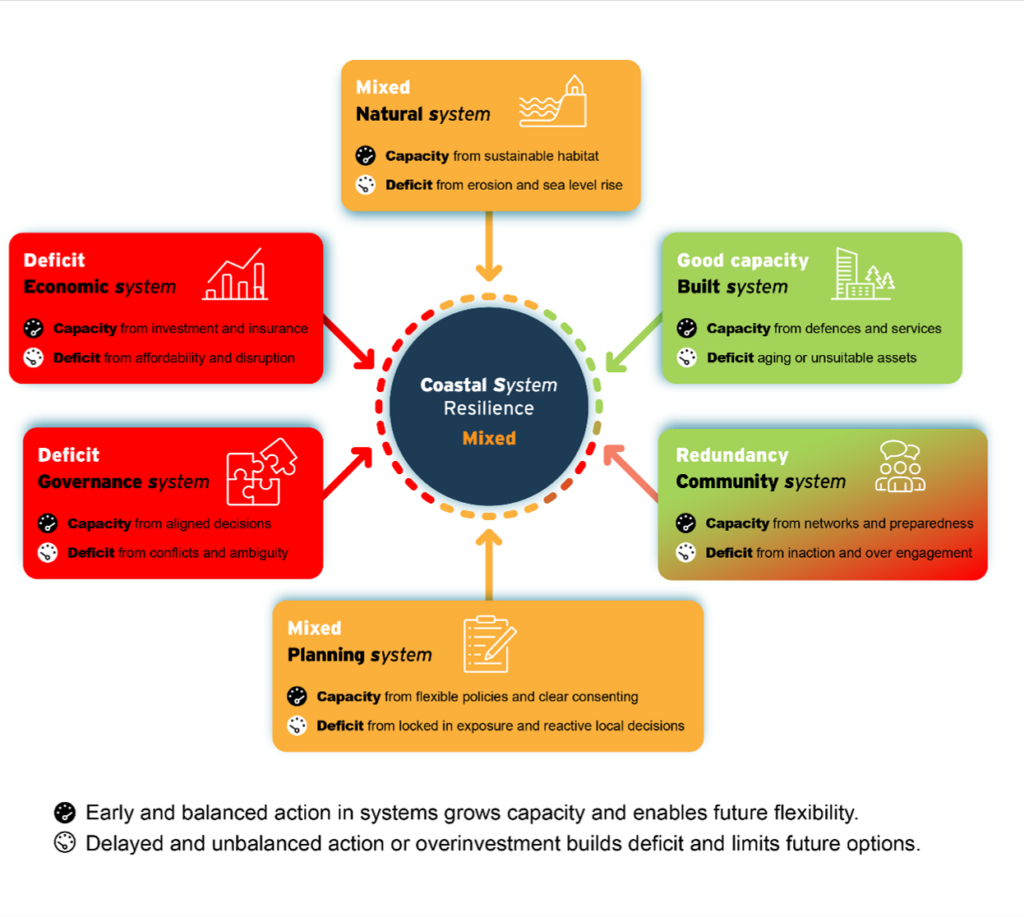
- systems – The distinct but interacting components that collectively shape coastal resilience (e.g., governance, environment, infrastructure/assets, people, funding). These systems are expressed through a set of resilience themes in the Coastal Resilience Framework to support a clear and accessible understanding of the System.
- Adaptation – A continuous process of revising decisions, plans, investments, and actions to strengthen overall System resilience. Delivered in balance across systems to ensure a holistic approach that maintains essential functions, addresses deficits, and avoids excess or maladaptive capacity through redundancy.
- Capacity – The resources, capability and investment within a component system to manage coastal risk and change; too little can create deficits, while too much (over-investment in one area) can create imbalance and undermine overall resilience through redundancy.
- Deficit – A weakness or shortfall in a component system (for example, governance, evidence, funding or community capacity) that can undermine the resilience of the whole System.
- Redundancy – Excess or duplicated capacity within one component system that is not balanced across other systems. It can add cost, complexity or unintended consequences without improving overall resilience.
Coastal resilience has shifted from questions of whether and when change will occur to whether organisations and communities have the capacity to prepare for, manage and shape that change. Sea level rise, erosion, flooding and ecosystem change interact with communities, infrastructure, planning systems and governance structures in complex ways. In this context, resilience cannot be delivered through isolated projects or single interventions. It requires a System-of-systems approach.
One that brings together multiple independent systems of governance, environment, assets, people, places and delivery mechanisms, etc., into a coherent, consistent long-term framework. This framework defines the overall System resilience.
In coastal adaptation, it is delivery friction – the coordination, negotiation, legal, political, social and environmental challenges – that make it hard for decision makers and stakeholders to agree on, fund, and implement actions, even when clearly beneficial.
Our approach to coastal adaptation is designed to do exactly this: to help organisations put in place the enabling framework that allows adaptation to be planned, prioritised, funded and delivered over time, while remaining flexible to uncertainty.
A coastal System-of-systems
Coasts function as interconnected systems. Physical processes shape the natural environment, which in turn supports ecosystems, landscapes and economic activity. Alongside this sit social systems: governance, planning policy, funding, ownership, community values and decision-making structures. Deficit in any one part can undermine the whole. Likewise, too much system capacity (through overinvestment) can undermine the System resilience.
For example, we all know we cannot keep raising defences forever. If a defence overtops and the response is to focus investment and effort on building bigger and higher, overtopping (or failure) may still occur. In this instance, could raising defences actually decrease the System resilience while still increasing the capacity of one system (defences)? Here, could people, services and organisations impacted end up less able to cope, respond and recover than if effort and investment had been redirected to strengthening other systems?
We frame resilience using this thinking, recognising that whole System resilience emerges from the interaction between multiple component systems rather than from individual actions delivered in isolation. This framing underpins our Coastal Resilience Framework, which:
- Defines the component systems that together make up coastal resilience (e.g., governance, environment, infrastructure/assets, people, funding). Uses quantifiable metrics to track condition, change and performance within each component system.
- Establishes clear links between evidence, decisions and action reducing delivery friction.
This structured approach creates a shared language for decision-makers and supports resilience to be delivered through adaptation as a dynamic process rather than a fixed plan.
An enabling framework for effective coastal resilience and adaptation
Across our projects, the initial focus is not on solutions, but on establishing a framework that allows adaptation to be delivered in a coordinated and cost-effective way over time. Four interlinked elements consistently underpin this: governance, ecosystem thinking, delivery streams and integrated ownership.
Agile governance: reducing delivery friction
Strong and agile governance is fundamental to smooth delivery. Adaptation plans that sit outside existing decision-making structures will struggle to influence investment, land-use planning or asset management. We work with organisations to embed adaptation within established governance arrangements, ensuring it is aligned with statutory duties, corporate priorities, decision-making cycles and funding opportunities.
For local authorities, we have provided regional governance structures, linking adaptation plans explicitly to local development planning, flood risk management and service planning across the organisation and with cross-sector partners. This created clarity over roles, responsibilities and escalation routes, and ensured adaptation actions could be progressed through existing mechanisms rather than bespoke structures.
In the private sector, governance focused on integrating climate risk and adaptation into the organisations’ operational and investment decision-making, enabling long-term ownership of plans aligned with financial resilience and strategic objectives.

The ecosystem: aligning plans and partners
Adaptation does not sit in isolation. Effective delivery depends on how well it aligns with the wider plans, policies and initiatives that will influence delivery. The ecosystem.
This typically includes elements such as development planning, nature recovery, infrastructure investment and community strategies. Our approach explicitly maps these linkages, identifying where plans support one another, where conflicts may arise, and where joint action can unlock greater benefits.
Delivery streams: from plans to actions
A successful plan must demonstrate the ability to deliver. We therefore work to define clear delivery streams aligned to component systems. These reflect different types of action, such as:
- Evidence and monitoring.
- Policy and planning interventions.
- Nature-based and engineering measures.
- Community engagement and capacity-building.
These delivery streams are designed to operate in parallel, with monitoring, triggers and thresholds used to signal when decisions need to be reviewed or actions accelerated.
Clearly identified delivery streams promote balance of actions to make sure that over-investment in systems is avoided, and system deficits are identified early and corrected. Without this, there is a real risk that a skewed or biased action plan will develop, which will not move the entire System into an improved resilience space.
Enabling confident, integrated, long-term adaptation
Adaptation succeeds when ownership is shared across disciplines, departments and stakeholder groups. We emphasise integrated ownership, ensuring that adaptation is not seen as the responsibility of a single team but as a collective endeavour.
Adaptation is a long-term and potentially overwhelming process, influenced by uncertainty and change. To do this effectively, a consistent approach is needed. One which balances:
- risk (probability and consequence)
- capacity
- the ability to deliver
across all systems.
Our overall approach helps to move beyond isolated investments, short-term fixes, and stop-start studies. It provides the structure, governance and shared understanding needed to deliver through time.
At any point, a coastal System will sit somewhere on a moving resilience spectrum, shifting over time as different systems change. In many contexts, the starting point is typically a resilience deficit, where a traditional risk-management focus can increase capacity (for example, through improved defences) but may not meaningfully reduce the consequences once that capacity is exceeded.
Adaptation pathways are the tool needed to progress toward the target System resilience. These help detect shifts toward deficit in either system capacity or the ability to adapt, while also identifying and avoidingsystem redundancy to keep delivery sustainable.
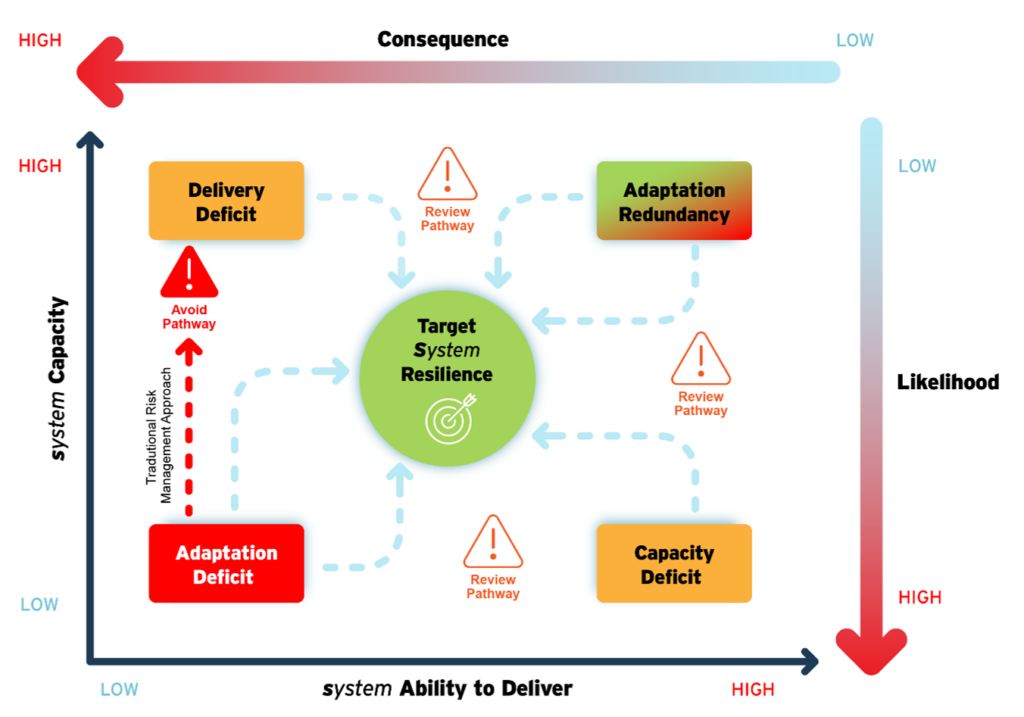
Defining such an enabling framework is not simply a theoretical exercise; it is a practical product of the System-of-systems approach. This enables objectives to be aligned early, information shared efficiently, and complementary opportunities pursued at pace. In turn, this will accelerate the transition from planning to implementation, ensuring delivery of effective coastal adaptation measures that enhance System resilience.

For more information about our work in coastal adaptation and resilience, contact Doug Pender, Technical Director, Marine and Coastal Risk Management.