
The Climate Resilience Podcast
Brought to you by JBA Consulting, The Climate Resilience Podcast brings together leading voices and fresh perspectives to explore one of the defining challenges of our time: what does it really mean to be resilient to climate change - and who needs to be involved to make it happen?
Hosted by Phil Emonson, JBA’s Climate Resilience Transformation Lead, the podcast features thought-provoking conversations with influential experts and practitioners from across the environmental sector and beyond. Together, they explore climate resilience in practice, the challenges of climate change adaptation, and the collective action needed to create a more resilient future.



Discover the latest Climate Resilience Podcast episode
Can we build climate resilience if we leave people digitally behind?
Technology is transforming how we forecast disasters, deliver warnings, and respond to emergencies. But who benefits - and who gets left behind? In this episode, Phil is joined by Monica Sanders, Georgetown University Law professor, National Geographic Explorer, and author of Climate and Code: Building Digital Justice in a Connected World, to explore the vital connection between digital inclusion, social justice, and climate resilience. They discuss how data and technology can help protect vulnerable communities, why digital exclusion can deepen existing inequalities, and what happens when the people most at risk can’t access the tools designed to keep them safe.
-
Episode overview

Resilience is about more than technology. From the connections we build in our neighborhoods to the everyday networks that support us through crisis, what really makes a community resilient? And can we harness innovation without losing sight of the people it’s meant to serve?
Join Monica and Phil for a thought-provoking conversation about digital justice, community power and building a climate-resilient future that leaves no one behind.
-
Key themes and talking points
- Climate resilience
- Community engagement
- Data and Technology
- Infrastructure
- Shared responsibility
-
Transcript
00:00:21 Phil Emonson
Hello and welcome to the Climate Resilience Podcast brought to you by JBA Consulting.
00:00:26 Phil Emonson
I’m Phil Emonson, and in this podcast series we unpick some of the complexities, challenges and opportunities on the topic of climate resilience with some inspirational thought leaders.
00:00:36 Phil Emonson
Whether you’re working on local adaptation projects, planning for climate risk or simply looking for hope backed by science, you’re in the right place.
00:00:44 Phil Emonson
If you enjoy these conversations, be sure to follow the podcast and subscribe wherever you listen.
00:00:49 Phil Emonson
Share with your friends and colleagues too, anyone interested in building a more resilient future.
00:00:54 Phil Emonson
Now, let’s jump into today’s episode.
00:01:00 Phil Emonson
My guest today is Monica Sanders, attorney, researcher and author, whose work focuses on sustainability, climate justice and emerging resilience technologies.
00:01:10 Phil Emonson
In her new book, Climate and Code, Monica makes a really compelling argument.
00:01:15 Phil Emonson
And that is that in a world increasingly shaped by climate change, internet access, digital literacy and access to information
00:01:24 Phil Emonson
are no longer issues of technology; they’re issues of resilience.
00:01:27 Phil Emonson
From disaster warnings and emergency relief to healthcare, education and economic opportunity, Monica argues that the communities most exposed to climate risk
00:01:38 Phil Emonson
are often the same communities being left behind digitally.
00:01:41 Phil Emonson
So today we’ll explore what digital justice means in practice.
00:01:45 Phil Emonson
And it’s a topic I can’t wait to get into.
00:01:48 Phil Emonson
We’ve lined this one up for a few months and really looking forward to it.
00:01:52 Phil Emonson
So Monica, welcome to the Climate Resilience Podcast.
00:01:55 Phil Emonson
And maybe you could start by just giving us an introduction to yourself.
00:02:00 Monica Sanders
Of course.
00:02:00 Monica Sanders
Thank you for having me, Phil.
00:02:02 Monica Sanders
I’m excited to talk about this topic with you.
00:02:05 Monica Sanders
Not that I’m biased or anything of that nature.
00:02:09 Monica Sanders
So you gave my job titles, and I still do all of those things.
00:02:15 Monica Sanders
But I am, as your audience can tell by the accent, from the United States, specifically from Southeast Louisiana, which is a part of the world that is at extreme risk from climate impacts.
00:02:29 Monica Sanders
It’s also a part of the world that is disconnected digitally.
00:02:37 Monica Sanders
Also, culturally rich has a lot of innovation, particularly when it comes to building resilience.
00:02:45 Monica Sanders
I think we’ll dig into some of those things.
00:02:48 Monica Sanders
And that informs how and why I do the work that I do, because I see in
00:02:57 Monica Sanders
the plight of Francophone Louisiana, similar impacts in Southeast Asia, parts of Latin America, and even parts of Central and Eastern Europe.
00:03:08 Monica Sanders
And also, when we’re talking about what’s happening in the United Kingdom and how many people were unaware of the risk that they faced this past weekend.
00:03:18 Phil Emonson
I just can’t wait to get into this.
00:03:19 Phil Emonson
It’s going to be great.
00:03:20 Phil Emonson
And so to get us going then,
00:03:26 Phil Emonson
we live in a digitally connected society.
00:03:32 Phil Emonson
The evolutions, the technological developments over the last few decades mean that we’re increasingly reliant on technology and digital data for all parts of our existence.
00:03:47 Phil Emonson
So from your research, let’s start by
00:03:53 Phil Emonson
looking at some of the great ways that disaster response and warning and forecasting are reliant on technology and how data and tech can be used for good, perhaps to reach and inform different parts of society, vulnerable populations, etc.
00:04:11 Monica Sanders
Yeah, we are able to access more information about almost anything faster than we have.
00:04:20 Monica Sanders
I think that it
00:04:21 Monica Sanders
than at any other point in human history.
00:04:22 Monica Sanders
And that also applies to emergency management.
00:04:25 Monica Sanders
And so let’s take a recent event.
00:04:29 Monica Sanders
I spent part of the year in Panama and was watching the attack and the response to that earthquake very carefully.
00:04:38 Monica Sanders
And there’s been a lot of comparisons, not necessarily impugning anyone, about the difference between the way people were affected in Panama versus the way people were affected in Colombia.
00:04:51 Monica Sanders
Panama has national 5G, and they’ve also been known to crowdsource their climate impacts.
00:05:00 Monica Sanders
So people had an early warning system in place, messages went to cell phones and devices, but what also is more important is that they had lower-technology warnings still in place, sirens and that sort of thing, so that you had a highly successful and informed evacuation,
00:05:20 Monica Sanders
that prevented serious injury and loss of life, unlike what happened in a country that was less digitally connected.
00:05:29 Monica Sanders
A few years back, I did a study with Panama where they worked with one of their sovereign indigenous communities on managed retreat because part of their territory was on barrier islands that were sinking and with sea level rise were quickly becoming uninhabitable.
00:05:46 Monica Sanders
Sure.
00:05:47 Monica Sanders
And again, they used a mix of geospatial analysis and machine learning to not just locate, but to de-risk the next place where these folks were going to live, as well as other social things that we like to hear when talking about the community having some agency in where they went and making sure it was culturally appropriate.
00:06:06 Monica Sanders
But the excellent use of technology was a geospatial imaging and machine learning to make sure that they were moving them into a place with a much lower long-term risk level
00:06:17 Monica Sanders
where they were moving from.
00:06:18 Monica Sanders
And so that’s the kind of thing from near-time early warnings to much longer forecasting that we can do with technology.
00:06:25 Monica Sanders
The question is, why are we doing more of it?
00:06:28 Phil Emonson
Whilst you were talking now, I was reminded of a scheme here in the UK where digitally disconnected populations – it’s a pilot area, but digitally
00:06:46 Phil Emonson
disconnected communities have been provided with Alexis for a whole number of benefits for those individuals, remind them to take medication at a certain point in the day, etc.
00:07:03 Phil Emonson
But it also enables the issuing of those early warnings and forecasts.
00:07:10 Phil Emonson
directly into homes.
00:07:13 Phil Emonson
And very early, very early trials.
00:07:16 Phil Emonson
I’m not aware yet of any of the outputs or the evaluations from that.
00:07:21 Phil Emonson
But there are some really great examples.
00:07:23 Phil Emonson
And the example you’ve given there from Panama, the earthquake impacts, is fabulous.
00:07:31 Phil Emonson
And here in the UK, we’re blessed with world-leading early weather warnings and forecasts from the Met Office.
00:07:40 Phil Emonson
and the Flood Forecasting Centre and how those are translated then into flood warnings, for example.
00:07:47 Phil Emonson
And those are distributed through TV and radio, but also the internet and mobile phones.
00:07:54 Phil Emonson
But there will be many people that those messages just don’t reach.
00:07:58 Phil Emonson
So I suppose then we’re talking about how data and tech can be used for good.
00:08:06 Phil Emonson
But I wonder then, does
00:08:09 Phil Emonson
digital connectivity and digital acceptance actually create division and amplify, risk amplifying underlying inequalities in and across society?
00:08:24 Phil Emonson
What do you think?
00:08:26 Monica Sanders
Yeah, I was like, that’s a lot to unpack because there’s division and there’s resistance in that sentence.
00:08:31 Monica Sanders
And I think both are true in very different ways.
00:08:39 Monica Sanders
I’ve been reading different articles in the conversation, both challenging resilience as a concept as well as the back of October, the International Day of Disaster Risk Reduction and says like resilience starts at home.
00:08:58 Monica Sanders
And people saying, well, what does this mean other than telling me I’m responsible for whatever happens?
00:09:04 Monica Sanders
So you’re telling me I’m going to flood.
00:09:06 Monica Sanders
You’re telling me I’m going to have a drought.
00:09:10 Monica Sanders
what do I need to do about it at home, quote unquote.
00:09:14 Monica Sanders
And so there is a real issue with creating that sort of resistance to the concept, which leads to people not participating in the resilience-building or preparatory activities.
00:09:27 Monica Sanders
And then also, particularly when we’re talking about governments or intergovernmental institutions, what those activities look like
00:09:39 Monica Sanders
and how the benefits and resources are parsed out links almost directly, if not inextricably, to our eroding trust in those institutions.
00:09:52 Monica Sanders
Because I’ve seen it in the United States, where FEMA, our federal emergency management agency, FEMA, FEMA employees were accused of not providing relief support to people who are at political odds with them.
00:10:09 Monica Sanders
and relief not being provided to states that were at political office with the executive branch.
00:10:15 Monica Sanders
I’ve also seen some mistrust in other countries, particularly in response, but also some resilience-building activities, it being packaged too closely to law enforcement and that kind of division.
00:10:29 Monica Sanders
So I’ve seen political division over law enforcement theory get tangled up with resilience building and emergency management.
00:10:37 Monica Sanders
But then also the lack of clarity about who’s responsible, and how do we partner, and how do we actually execute some of these ideas, creating resistance to the concept.
00:10:50 Phil Emonson
Yeah, There’s a lot there in your reply, actually, to that.
00:10:54 Phil Emonson
And I think I could talk about this all day.
00:10:56 Phil Emonson
This is golden stuff.
00:10:59 Phil Emonson
The concept of resilience, resistance is a really interesting one.
00:11:03 Phil Emonson
And there’s a
00:11:04 Phil Emonson
There’s a paper that’s been published in the UK by a good friend of mine, Dr Paul O’Hare from Manchester Metropolitan University recently, where he has researched communities who have been on the receiving end of initiatives to build their resilience.
00:11:24 Phil Emonson
And there has been a lot of resistance to that.
00:11:26 Phil Emonson
These communities have felt as though it is being done to them, not with or for them.
00:11:33 Phil Emonson
and that it is sidestepping the responsibilities of central government to better protect them in this case, in the face of increasing risk of flooding.
00:11:45 Phil Emonson
But you’re right, we all have a responsibility to build our own capabilities and resilience.
00:11:53 Phil Emonson
In fact, just within the last week here in the UK, the government have launched A Be Ready campaign, which says, you know what,
00:12:02 Phil Emonson
There might be things that disrupt our way of life from natural hazards.
00:12:08 Phil Emonson
So you mentioned floods and storms and droughts.
00:12:14 Phil Emonson
But it might be other things.
00:12:15 Phil Emonson
It might be
00:12:16 Phil Emonson
a gas leak, and we have to leave our homes for a period or whatever.
00:12:20 Phil Emonson
And we need to be ready for that.
00:12:22 Phil Emonson
And there’s a lot of things that the state can do, but actually there’s a lot of things that we can do at home, like just making sure we’ve got enough bottled water in or we’ve got a little checklist of things we might want to take with us if we need to leave home.
00:12:35 Phil Emonson
And of course, for some communities,
00:12:40 Phil Emonson
That’s quite straightforward because people have got the agency; they’ve got the capacity to go out and buy another phone charger, or they’ve got the time to plan for this stuff.
00:12:51 Phil Emonson
But actually, if we’re looking at the concept of justice and just resilience, then actually we need to think about inclusion.
00:13:01 Phil Emonson
And climate resilience shouldn’t be pursued in isolation from those wider social justice outcomes, I think.
00:13:10 Phil Emonson
and it is very much about doing it, doing it with and for communities.
00:13:20 Phil Emonson
And I always think that climate resilience should be built in ways that gives communities the agency and the resources
00:13:33 Phil Emonson
to shape the places and the futures that they want and that matter to them.
00:13:38 Phil Emonson
And you mentioned trust as well there.
00:13:40 Phil Emonson
I mean, that’s a big topic, isn’t it?
00:13:43 Phil Emonson
And trust, trust comes over time, doesn’t it?
00:13:48 Phil Emonson
And in many respects, it’s the foundation of resilience, isn’t it?
00:13:52 Phil Emonson
And I think our organisations and our institutions, and our authorities need to invest in honest and reliable
00:14:02 Phil Emonson
long-term relationships so that communities have that confidence.
00:14:06 Phil Emonson
And what you’ve just been talking about there, about the political dimension, the political sort of interference that you described, is quite fascinating to hear from our part of the world, where, thankfully, you know, we don’t have that in our emergency response or emergency management, you know, efforts.
00:14:29 Phil Emonson
So on the digital point then,
00:14:32 Phil Emonson
this whole point of sort of digital justice, which of course is very interwoven with just resilience.
00:14:40 Phil Emonson
So I suppose there is a bigger question then: is climate resilience impossible without digital justice?
00:14:53 Phil Emonson
it’s a big question, I know, but I wonder what your thoughts are, Monica.
00:14:58 Monica Sanders
It’s possible for some people in some places.
00:15:02 Phil Emonson
Yeah.
00:15:05 Monica Sanders
And it breaks by income levels and access to stable, reliable, trusted public infrastructure, whether that be public infrastructure or digital infrastructure.
00:15:20 Monica Sanders
Right.
00:15:21 Monica Sanders
You and I, when we pick up our phones, whether it’s Florrow or it’s Verizon or it’s another servicer, depending on where we are in the world,
00:15:33 Monica Sanders
We trust that connection with our phones.
00:15:37 Phil Emonson
Yeah.
00:15:39 Monica Sanders
That is not true in parts of the American South, sub-Saharan Africa, huge swaths of Asia.
00:15:50 Monica Sanders
Even something as low-level as that, without even getting into
00:15:55 Monica Sanders
bridges and highways and political infrastructure, all of those institutions, right?
00:16:01 Monica Sanders
And whatever neighbourhood you and I live on, every time we drive across a bridge, we’re fairly confident that bridge will hold.
00:16:09 Monica Sanders
But that is not true in a lot of places.
00:16:12 Monica Sanders
And so when we’re talking about digital justice, or even in the example, excuse me, that you were just saying, you know, the time to do the resilience activities,
00:16:24 Monica Sanders
Many salaried employees have work from home or teleworking or sometimes, depending on what time of the year it is, if it’s hurricane season where I live, I’m taking Zoom calls while I’m in Home Depot.
00:16:40 Monica Sanders
So I don’t stop work.
00:16:42 Monica Sanders
I don’t lose resources to do what I need to do to build resilient at home.
00:16:47 Monica Sanders
So I’m talking about digital justice is the fact between
00:16:53 Monica Sanders
the layered impacts of some communities not having decent public infrastructure, either no roads or lack of roads, no bridges, no high towers.
00:17:06 Monica Sanders
So that means no fibre optic cable, no decent cell towers or Wi-Fi access to everything that’s connected to that.
00:17:19 Monica Sanders
the opportunity to work and not lose income or salary and still have physical mobility, it’s driven by the internet.
00:17:29 Monica Sanders
The difference in pay between a white-collar or digitised workforce or digitised workplace versus being a subsistence farmer or delivery driver or some of those things, right?
00:17:43 Monica Sanders
Because it gives you time and it gives you trust and infrastructure around you.
00:17:47 Monica Sanders
And when you don’t have that,
00:17:49 Monica Sanders
all of these things become much more difficult by an order of magnitude.
00:17:55 Monica Sanders
And so I don’t think that you can divorce climate resilience from the simple fact that as we build digital economies in a lot of places, all we’re doing is moving pre-existing social justice issues, whether it’s redlining or oddly drawn colonial lines that have created other kinds of division and
00:18:19 Monica Sanders
investment to just simply neighbourhood gentrification and population movement and moved it into digital spaces.
00:18:30 Monica Sanders
And so we need to reconcile if we actually want to build resilience that everyone may not have the same opportunity of flexibility, but they should have equitable opportunities, like understanding that for some people, it may mean
00:18:47 Monica Sanders
access to a cell home or having hardline internet brought to their community as a public utility if it’s not economically feasible for the private corporation so that they have more options about how they’re going to access information and do different things.
00:19:11 Monica Sanders
If we don’t consider these things, and what we have is similar to
00:19:16 Monica Sanders
the core reason why we have a G8 and a G20 in the rest of the world.
00:19:23 Phil Emonson
And so it strikes me then that when planning for climate resilience, actually we should be starting with the priorities that matter most to people in their community because climate is likely to be on the list.
00:19:43 Phil Emonson
But it is often the case that there will be more
00:19:46 Phil Emonson
appropriate and meaningful entry points, such as health, the cost of living, well-being, economic opportunity you mentioned, housing, or those pre-existing inequalities and using those as our motivator.
00:20:10 Phil Emonson
We know that climate risks won’t affect everybody equally.
00:20:14 Phil Emonson
And we’re starting to see a real focus here in the UK on this topic of just resilience, and that is, doing climate change in a way that avoids deepening those inequalities that already exist, and actively including
00:20:40 Phil Emonson
perhaps those communities that may traditionally have been overlooked or not included.
00:20:51 Phil Emonson
and as I said earlier, we shouldn’t be pursuing climate resilience in isolation from those other factors.
00:20:59 Phil Emonson
And you’ve just described that beautifully there, Monica.
00:21:05 Phil Emonson
and it ties into things, doesn’t it?
00:21:07 Phil Emonson
Like opportunity to work and economic mobility, like you say.
00:21:15 Phil Emonson
So I work for JBA Consulting, as you know.
00:21:21 Phil Emonson
We provide a lot of services to the public sector here in the UK.
00:21:28 Phil Emonson
So organisations like our environmental agency, local authorities,
00:21:35 Phil Emonson
And we are practitioners in this climate-resilient space.
00:21:40 Phil Emonson
We do things to better protect communities from flooding, to raise awareness, to support adaptation or more effective response and recovery.
00:21:50 Phil Emonson
So what is it then, Monica, that people like I and my colleagues and the practitioners that we work, I work amongst, how do we need to think differently and what do we need to do differently to
00:22:03 Phil Emonson
ensure equitable digital inclusion as part of that wider climate resilience piece?
00:22:11 Phil Emonson
Do you think?
00:22:12 Monica Sanders
It is starting with the community first.
00:22:18 Monica Sanders
We have a tendency, and I’ll take some of the guilt in this as being a researcher, to have resilience activities be defined by academia and government.
00:22:28 Monica Sanders
And so that’s how you get weird things like, oh, we’re going to go into this community and build them a green wall.
00:22:35 Monica Sanders
And the people in the community are like,
00:22:38 Monica Sanders
He doesn’t have access.
00:22:40 Monica Sanders
I don’t give a loss about this wall.
00:22:43 Monica Sanders
Why are you here doing this?
00:22:47 Monica Sanders
Or as we say where I’m from, why do you keep coming when no one sent for you?
00:22:51 Monica Sanders
Which that’s a…
00:22:52 Phil Emonson
Yeah.
00:22:53 Phil Emonson
Right.
00:22:56 Monica Sanders
Whereas for that community, the correct, the appropriate intervention, as you said, might be about building
00:23:07 Monica Sanders
clinics so that they have access.
00:23:10 Monica Sanders
But you can also put up sensors to measure their heat and flood risk and then determine from this first point of entry and trust and collaboration with the agencies, right?
00:23:23 Monica Sanders
What is the actual climate issue in that particular neighbourhood or that particular community or sea?
00:23:31 Monica Sanders
And then work from there.
00:23:33 Monica Sanders
Because I think
00:23:36 Monica Sanders
One of the other times you and I were chatting informally, I talked about in my research, I did a head-to-head comparison between Manchester and Altar.
00:23:45 Monica Sanders
And I was interested in their unique histories when both were under British rule about heavily industrialised areas.
00:23:54 Monica Sanders
And at some point, it just became okay that these were cities where the heavy industry would be.
00:24:00 Monica Sanders
And so each time there is a flooding event in those places, there’s also literally centuries of unremediated contamination.
00:24:10 Monica Sanders
It drives other climate issues and public health issues.
00:24:14 Monica Sanders
And so when we were working in Baltimore, we confronted the public health issues first because that’s what was most present in folks’ minds.
00:24:27 Monica Sanders
And then using that, we were able to explain, your respiratory issues, skin issues have to do with this.
00:24:35 Monica Sanders
And this is the government function to remediate some of these things.
00:24:42 Monica Sanders
And so can we work with you to get you to trust the government?
00:24:45 Monica Sanders
I think practitioners need to
00:24:50 Monica Sanders
start, meet people where you find them to use a cliché, but also be open to the fact that while it may not be presented as a professional in the space, the community knowledge is often very deep and extremely historically accurate and can give you way better data than what you would get from using technology alone or research alone.
00:25:14 Phil Emonson
What you’ve just said there, and I’m smiling now, it was something that came through very strongly just on our last episode.
00:25:24 Phil Emonson
And I actually referenced a much earlier episode of the podcast when a friend of mine, good chap, Carl Astbury from the Resilient Cities Network, was on.
00:25:34 Phil Emonson
And he used the phrase flatten the hierarchies.
00:25:37 Phil Emonson
You know, we have this idea that
00:25:41 Phil Emonson
technical knowledge, technical expertise, professional bodies and institutions are more valuable than the local people who understand community dynamics, history, local culture.
00:25:57 Phil Emonson
And actually, we need to place both of these on an equal footing.
00:26:01 Phil Emonson
And that was exactly the point you’re making just there.
00:26:04 Phil Emonson
And I think you mentioned, place the community first.
00:26:09 Phil Emonson
give them the respect that they know what’s going on in their communities; they know what’s important.
00:26:15 Phil Emonson
And we shouldn’t be parachuting in.
00:26:18 Phil Emonson
And, actually, there’s a lot of strength in communities.
00:26:26 Phil Emonson
Communities already have a variety of assets or culture or history or strength of place, local networks, the tiny threads that make up our communities.
00:26:39 Phil Emonson
And those can be really strong and really valuable.
00:26:42 Phil Emonson
And I think often we aren’t valuing those as much as we should, but rather we’re going in on a particular theme or motivation around trying to fix a climate problem.
00:26:59 Phil Emonson
And there’s those traditional power hierarchies that need to be rebalanced so that we can
00:27:09 Phil Emonson
create conditions where people can feel empowered and have the resources and the agency to act.
00:27:19 Phil Emonson
And it’s really interesting what you’re saying, Monica, because it’s come up on so many previous episodes of the podcast, and I think something that somebody said to me recently is,
00:27:35 Phil Emonson
we don’t value people’s time commitments.
00:27:39 Phil Emonson
If I’m going to a community event to do with footing, I’m being paid, right?
00:27:45 Phil Emonson
That’s part of my job; I’m being paid.
00:27:46 Phil Emonson
But we just expect the community to come along and give their wisdom and their experience and their time and their expertise
00:27:58 Phil Emonson
Yeah.
00:27:59 Phil Emonson
I mean, that seems quite extractive, right?
00:28:01 Phil Emonson
So how are we meant to, or even tokenistic, I don’t know, but how are we supposed to engender some degree of cooperation if we’re not there on an equal footing?
00:28:15 Phil Emonson
So yeah, fascinating, fascinating to hear you.
00:28:20 Phil Emonson
reflect on those very same topics that have come up on different episodes over the years with the podcast.
00:28:26 Phil Emonson
So whilst we’re on them, whilst we’re on this point of society, and we’ve mentioned the assets, the value and those tiny threads that are woven into society through all of our everyday interactions in
00:28:43 Phil Emonson
our schools or on our high streets or on the places of worship, whatever it is that we’ve got in society.
00:28:52 Phil Emonson
another big question for you, I suppose, and I think I know the answer, but I’m going to ask it anyway.
00:28:58 Phil Emonson
In terms of resilience for communities, what’s most important?
00:29:03 Phil Emonson
Is it that those societal characteristics
00:29:11 Phil Emonson
Or is it the value that innovation, technical advancements can make in terms of supporting an efficient and effective response?
00:29:23 Phil Emonson
As I say, I think I might know what the answer is going to be, but I’m so interested just to hear your reflections on this because it brings together all the different strands of the conversation so far.
00:29:33 Monica Sanders
For me, it is the former, but with these conditions.
00:29:40 Monica Sanders
is understanding that our interpretation of the word technology can sometimes be quite specific.
00:29:50 Monica Sanders
And we need to recognise that there’s gradations and varying definitions of that word.
00:29:55 Monica Sanders
And for many places, it’s inextricably intertwined with culture.
00:30:01 Monica Sanders
You have people where I’m from that have been doing climate resilience for centuries.
00:30:10 Monica Sanders
But to them, it’s recycling oyster shells after a fake photo.
00:30:17 Monica Sanders
It took scientists 20 years to realise that every time people who are from the indigenous and Cajun, and Creole communities in Southeast Louisiana, where they were oystermen,
00:30:35 Monica Sanders
or if there had just been an event, right?
00:30:37 Monica Sanders
Because you’ve seen us on television, we like an event down there.
00:30:42 Monica Sanders
Returning the oyster shells to the bay actually was helping with the coastal erosion.
00:30:50 Monica Sanders
The high, high, locally, they knew it.
00:30:53 Monica Sanders
They knew that preserving the cypress trees and that the minerals from the oyster shells were good for the vegetation, and that was good for the entire ecosystem.
00:31:02 Monica Sanders
That’s climate resilience work.
00:31:05 Monica Sanders
It is a type of technology to at a community level at scale because this aggregated, we’re talking about miles and miles of coastline.
00:31:18 Monica Sanders
And so when we get so stuck on the ladder, we’re talking about technology to make things more efficient.
00:31:25 Monica Sanders
It’s very easy for our imagination to carry us places like putting data centres on the moon and that sort of thing, that kind of definition of technology, which is incredibly innovative, but by a very small segment of the population where in other places it is intertwined with culture.
00:31:43 Monica Sanders
And so not only flattening the hierarchy, but also being willing to understand that in some places,
00:31:50 Monica Sanders
particularly where you’re dealing with people whose contributions to humanity exceed modern society by centuries, if not millennia, they just might know better than you.
00:32:01 Monica Sanders
They may use different terminology, but they’ve been doing climate resilience work to live in this place and adapt to this place as it’s changed throughout the course of their human record.
00:32:15 Monica Sanders
They may know better than you.
00:32:16 Monica Sanders
So it’s more important to me
00:32:18 Monica Sanders
to understand not just the exclusion, but also the underestimation of place and culture and people that we have formerly divested.
00:32:30 Phil Emonson
That’s wonderful.
00:32:31 Phil Emonson
And a bit of humility, actually, as you say, just acknowledging that people have been doing this.
00:32:38 Phil Emonson
They know their landscape, their ecosystem.
00:32:42 Phil Emonson
They know their place.
00:32:46 Phil Emonson
Yeah.
00:32:47 Monica Sanders
They know their placement sometimes have skills that we don’t have.
00:32:52 Monica Sanders
One of my most humming experiences was in Baltimore, where we were putting up fixed Wi-Fi with the community and we didn’t think to talk to the returning citizens because
00:33:01 Monica Sanders
Fortunately, in my life, I’ve always been on the other side of the prosecutorial system, so I’ve never been incarcerated.
00:33:08 Monica Sanders
I had no idea that people learned how to solder and weld in there.
00:33:11 Monica Sanders
So there were returning citizens that knew way better than we did about how to install Wi-Fi towers.
00:33:20 Monica Sanders
And that is a source of resilience-building skill sets that was sitting right in front of our faces, and we just didn’t have the ability to see it.
00:33:33 Monica Sanders
And those gentlemen brought all kinds of benefits, not just putting up the fixed-point Wi-Fi.
00:33:41 Monica Sanders
We worked with the Department of Labour to get their work certified.
00:33:44 Monica Sanders
So some of them got other related positions, which brought financial benefits into a depressed part of the community.
00:33:51 Monica Sanders
But some of them just liked doing it.
00:33:54 Monica Sanders
and took the process from us and went and connected other communities and other parts of communities that knew and trusted more than us and expanded the project more than we ever would have with our capacity and my money.
00:34:05 Monica Sanders
Only because by sheer force of personality, one of them looked at me and says, you do not look like the kind of person who knows how to weld.
00:34:14 Monica Sanders
And I was like, sir, you are correct.
00:34:17 Monica Sanders
And we moved from there.
00:34:20 Monica Sanders
And what are some very, hyper-local example?
00:34:25 Monica Sanders
We, the privilege, the holders and gatekeepers of resources, do this to people all over the world.
00:34:32 Phil Emonson
Yeah, Final question, Monica, because we are sadly approaching the end.
00:34:37 Phil Emonson
It’s been fascinating.
00:34:39 Phil Emonson
But in reflection then of your book and I suppose the conversation we’ve just had,
00:34:46 Phil Emonson
And this is a question I often finish with now on the podcast, but what gives you hope?
00:34:53 Monica Sanders
Young people give me hope, whether they are showing up at protests, calling out issues that we need to pay attention to.
00:35:05 Monica Sanders
The ones that show up in my classrooms
00:35:09 Monica Sanders
Eager not to just learn from an esoteric point of view, wanting to learn very concrete, specific skills because we want to solve problems.
00:35:22 Monica Sanders
Also watching some of them move into leadership positions and pushing us in a different way.
00:35:27 Monica Sanders
Because I’m in a place in my life where I can look at Zohran Mamdani and say, I’m proud of this young man.
00:35:37 Monica Sanders
because he’s thinking holistically about these things in New York City.
00:35:41 Monica Sanders
He’s having international influence.
00:35:43 Monica Sanders
I just watched this engagement between he and Prime Minister Sanchez in Spain saying like, we can do social justice and economic restoration.
00:35:53 Monica Sanders
I think was, if I’m translating it correctly, when I heard his speech in Spanish referring to Prime Minister Sanchez and climate resilience all at the same time because we have to.
00:36:03 Monica Sanders
That gives me hope.
00:36:04 Monica Sanders
when I see this gradation of pointing out issues, developing skills to leading, then maybe one day I’ll be able to safely go to the old lady’s home and not live in a climate-impacted hellscape because these young people are so driven and inspired.
00:36:20 Monica Sanders
So that’s what gives me hope.
00:36:24 Phil Emonson
Wonderful.
00:36:25 Phil Emonson
Wonderful.
00:36:25 Phil Emonson
What a what a beautiful positive place to finish on.
00:36:30 Phil Emonson
Monica, that’s been golden.
00:36:32 Phil Emonson
It’s been wonderful.
00:36:33 Phil Emonson
And it’s a shame that we’ve come to an end.
00:36:36 Monica Sanders
Thank you.
00:36:37 Phil Emonson
Yeah, Monica Sanders, thank you for coming on the podcast.
00:36:42 Monica Sanders
Thank you for having me and supporting my work.
00:36:45 Monica Sanders
And thank you for everything that you do on this podcast and in your consulting work.
00:36:50 Monica Sanders
I really do wish you all the success.
00:36:53 Phil Emonson
Thank you.
00:36:54 Phil Emonson
Thank you very much.
00:36:57 Phil Emonson
So we’ve reached the end of our time today.
00:36:59 Phil Emonson
If you’ve enjoyed listening, please hit the subscribe button so you’re ready for our next episode in a month’s time.
00:37:04 Phil Emonson
And if you’d like to support the show, consider sharing it with others or leaving us a short review wherever you’re listening.
00:37:11 Phil Emonson
It really helps more people to discover and enjoy the podcast.
00:37:14 Phil Emonson
Thanks for joining us.
00:37:15 Phil Emonson
I’m Phil Eminson and you’ve been listening to the Climate Resilience Podcast brought to you by JBA Consulting.
00:37:25 Monica Sanders
That’s what gives me hope.
Meet our latest guest
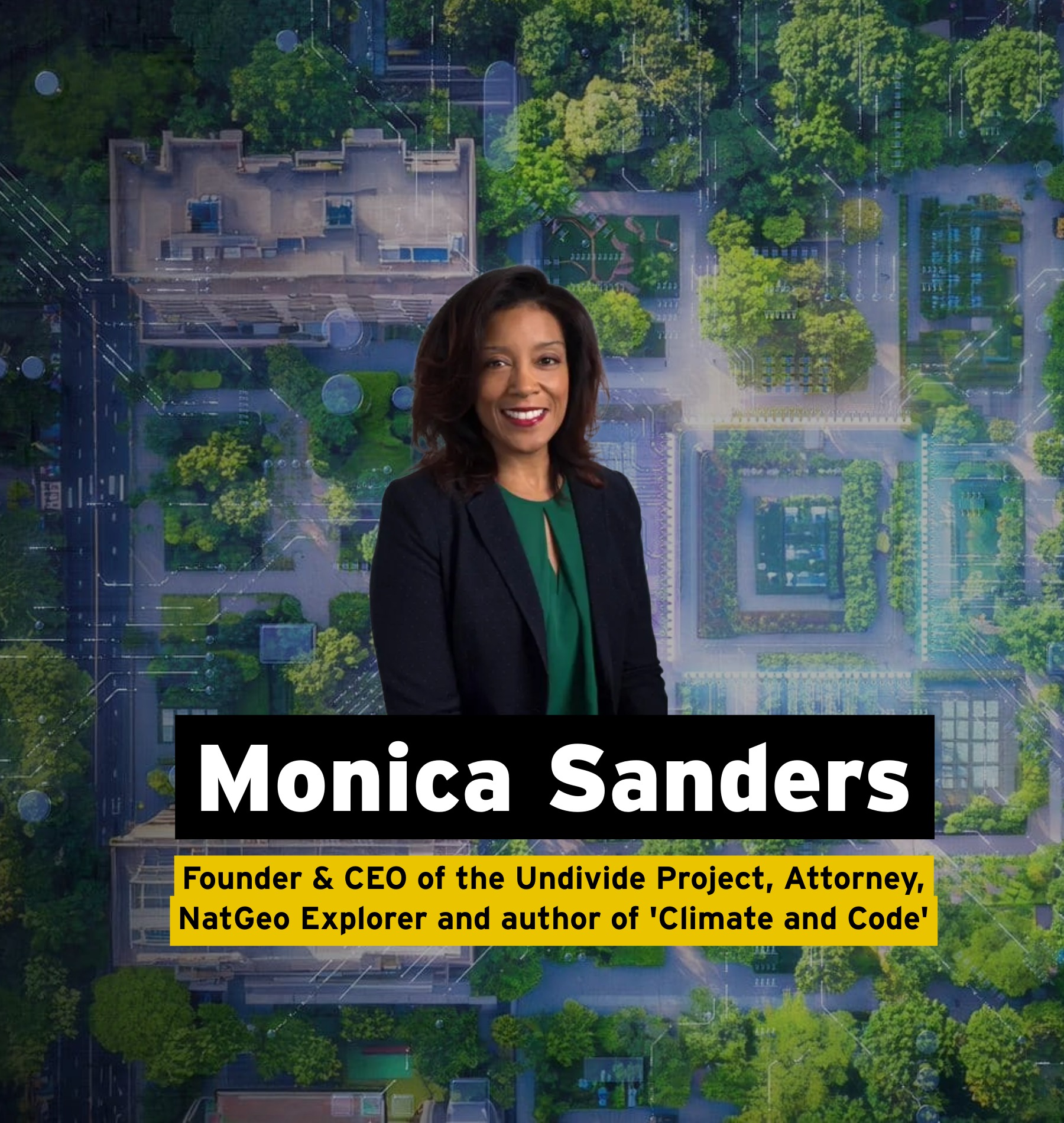
Monica Sanders, JD, LL.M, makes a practice of looking into chaos to find justice. A New Orleans native, her life was bifurcated by Hurricane Katrina and the injustices it revealed, an experience that shaped her lifelong focus on disasters, climate change, and digital equity. She now teaches Disaster Law at Georgetown University Law Centre, where her work sits at the intersection of climate resilience and technology access.
Her earlier careers as Senior Legal Advisor for International Response and Programs at the American Red Cross and as Senior Committee Counsel for both the House and Senate Homeland Security Committees, gave her a combination of ground-level disaster response and federal policy oversight, shaping the question at the centre of her work: when emergency relief systems go digital, who gets left out? As founder of The Undivide Project, Monica works directly in Southeast Louisiana, Baltimore, and Puerto Rico, communities where climate risk and the digital divide overlap.
Listen again or catch up on recent episodes...
We're committed to tackling the biggest climate resilience questions - and we'd love to hear from you. Whether you'd like to join us as a guest, suggest a topic, or simply share your feedback, click here to contact us.
 Read more

