
The Climate Resilience Podcast
Brought to you by JBA Consulting, The Climate Resilience Podcast brings together leading voices and fresh perspectives to explore one of the defining challenges of our time: what does it really mean to be resilient to climate change - and who needs to be involved to make it happen?
Hosted by Phil Emonson, JBA’s Climate Resilience Transformation Lead, the podcast features thought-provoking conversations with influential experts and practitioners from across the environmental sector and beyond. Together, they explore climate resilience in practice, the challenges of climate change adaptation, and the collective action needed to create a more resilient future.


Discover the latest Climate Resilience Podcast episode
What does it take to build climate resilience that works for everyone?
Fresh from JBA's recent Climate Resilience Exchange event exploring the delivery of the UK Government Resilience Action Plan, Phil catches up with Jo Kerr, CEO of Verture and chair of the event. Together, they explore the importance of community resilience and how we can move beyond traditional, top-down approaches to climate resilience, empowering people and communities to shape their own futures.
-
Episode overview

Drawing on discussions from JBA’s recent Climate Resilience Exchange event, Jo and Phil explore why social justice and climate resilience are inseparable, the importance of valuing lived experience alongside technical expertise, and how community assets, local connections and creativity can help build more resilient places. They discuss what meaningful co-production looks like in practice, why communities should be supported and resourced to lead change, and how professionals and policymakers can create more equitable pathways to resilience.
With a focus on collaboration, shared responsibility and the power of community, this conversation offers an inspiring vision of a more just and resilient future.
-
Key themes and talking points
- Climate resilience
- Social justice
- Community engagement
- Collaboration
- Shared responsibility
- Policy
-
Transcript
Phil Emonson 0:02
Hello and welcome to the Climate Resilience Podcast brought to you by JBA Consulting. I’m Phil Emundsen, and in this podcast series, we unpick some of the complexities, challenges, and opportunities on the topic of climate resilience with some inspirational thought leaders. Whether you’re working on local adaptation projects, planning for climate risk, or simply looking for hope backed by science, you’re in the right place. If you enjoy these conversations, be sure to follow the podcast and subscribe wherever you listen. Share with your friends and colleagues too, anyone interested in building a more resilient future. Now, let’s jump into today’s episode. The UK government’s resilience action plan sets out an ambitious vision for a whole of society approach to resilience. But what does that mean in practice? And how do we move beyond seeing resilience as the responsibility of government and our emergency responders, and instead create conditions for people and communities and businesses to play a meaningful role in shaping a more resilient future? Well, these were some of the questions that we explored at JBA’s latest uh climate resilience exchange roundtable, held in London during Flood Action Week. These exchange roundtables series brings together uh leaders and executives from across different sectors to explore the many challenges and opportunities of creating a more resilient future. This latest session focused on creating equitable and participatory and empowering pathways to climate resilience. And the discussion examined how resilience can be built in ways that give communities a genuine influence and can how they can strengthen local capability and ensure that responsibility is matched with power and resources and investment. Joining me today to reflect on those conversations is Joe Kerr, CEO of the climate resilience charity Virtua. Joe very kindly chaired the round table for us. And in this episode, we’ll explore what a genuinely participatory approach to climate resilience looks like and what just resilience is all about. So, Joe, welcome to the podcast. It’s great to have you. And maybe you could start by just giving us a short introduction of yourself.
Jo Kerr 2:17
Thank you so much, Phil. And it was brilliant to be with you as well at the round table last week. I found it incredibly energizing and motivating, and um you convened a brilliant group. So thank you for having me there. Um, so I am now the CEO of Verature. I’ve been in post for two years. My journey to Verature as a climate resilience charity was maybe not what you’d expect. Well, for a start, I did an English literature degree. So I work with a lot of geographers, a lot of engineers, built environment people. Um, and I come from quite a different background in terms of what I studied. And then most recently, uh, before Varcher, I was a director at an anti-poverty charity called Turn to Us. So I come from the social justice space, looking into working into the climate justice space. And at Turn to Us, we went on a real journey of from about 2018 going, we’re not a climate charity, we’re not going to do anything on climate really. To now they are really facing into climate and acknowledging that for the people who are on the lowest incomes, who have the most vulnerability to climate impacts, we need to be focusing work there. And then two years ago, I had the fantastic opportunity to move over to Varcher. And some of your listeners might know us as Sniffer, which was our previous name with our 30-year track record, and um moved over there and did our big rebrand. And now with our just resilience strategy, we are looking at this same kind of problem space, but very much from that climate resilience perspective. And we’re finding that certainly when you work with communities and you look at what is making you um more going to make you more resilient to climate change and climate impacts, it’s also the things that are going to make people’s lives better in many other ways, and even down to putting more money in their pockets. So um, yeah, it’s it’s this it’s a system-wide problem, system-wide challenge, and um therefore systemic solutions. And I guess that’s what keeps me getting up in the morning and um what I draw a lot of energy from is tackling these challenges.
Phil Emonson 4:39
Brilliant. And that’s why you were the perfect chair for our event. It was um, I think, yeah, I mean, you’ve alluded to it there, social justice and climate resilience are inseparable now, and I’m really looking forward to getting into this conversation uh about just resilience. And and and the exchange round table, I think, was a real success. And we had some really thought-provoking discussions um in the room. We had representation from uh academia, we had professional um societies uh like SIWEM and the Emergency Planning Society, we had utilities and water companies, we had the voice of youth, we had race equality, we had organizations like Resilient Cities Network and the VCS Emergencies Partnership. So we had a really interesting breadth of perspectives, and I think that’s what that’s what gave rise to these really interesting discussions. We get started then, Joe, by discussing what good community resilience looks like and and and what we’re aspiring to. And and and maybe you could reflect on on that to start with.
Jo Kerr 5:50
Well, it was lovely, wasn’t it? Because we had a bit of our icebreaker where we were all thinking about what might make our own communities where we live, or or where, or even our communities of practice and our work, or um communities of identity, what might make them more or less resilient. And I think that’s really important because often we can sort of think as middle class professionals, I see it all the time, the community is what happens over there with people who are maybe on lower incomes or experiencing marginalization. They they need to be in a community sorting themselves out, which is um a very weird thing that um we do see. But we’re all we all have the opportunity to be part of community. We’re all in community. And I I really believe that to reach true resilience and true climate resilience, the smallest kind of unit of that is the community. So it’s it’s really thinking about how do how do we strengthen and um in terms of of what the kind of critical success factors are, I suppose you know, one thing is um income. So it is very difficult, or I would say impossible to be climate resilient if you you, your community are experiencing poverty. So that link between um the kind of financial security and um those other forms of security, I think, is vital. Um, we see this in um communities where we’ve worked as virtue. So, examples of our creative climate futures project um in Easterhouse and the Gorbles, and those are two neighborhoods in Glasgow that have historically experienced quite a lot of challenge. Um, we talk about deprivation is a term that’s used. Um at the same time, though, those communities have like a really rich history, lots of passion, um, lots of connection, social connections, social bonds. And that is a route to really good resilience. Like you need to know your neighbors and the really positive examples, which maybe you can go into a couple of them, um, in Easter House and the Garbles, it’s where those community connections and the relationships were leveraged to create greater resilience. And then taking more of that asset-based approach so we can look at the challenges, we can look at the marginalization, we can look at the, you know, maybe discrimination, the things that divide us, you know, particularly now in the kind of polarized, um, more polarized environment. But we, you know, we can flip it and say, what are the assets that that community has? And that might be about the green space that that community has and and how we’re able to use that. It might be about the community center, you know, is it the building, physical infrastructure? Is that being invested in? Is that a place that people can gather? Is that a warm space or a cool space? Or has it got the potential to become that? Um, so you know, there are so many dimensions. Um, can get into things like the food systems and um access. That’s something that certainly look at in um East House and the Gorbles as well, and just you know, what shops are available for people and how are the products in those shops impacted by um climate stress and supply chain and um pricing as well, and how does that affect people’s resilience?
Phil Emonson 9:32
There’s so many good examples, aren’t there? And and when you when you started the icebreaker in the room, I uh I reflected on the tiny threads, I think that was the phrase I used, that that I see in my community, small interactions day-to-day, um, often framed around the existing social infrastructure. So where I live, we have a thriving primary school, we have a church, we have a library with a a strong uh library community around it. Um, we’re very lucky. We have um we have a we have a butcher’s shop in the village, we have um uh children’s football teams, and all of these community assets give people the opportunity to create their own community within a community, little networks, little threads, little bonds. And it comes back to that asset-based community development thing, doesn’t it? Every community already possesses assets, local institutions, networks, culture, local knowledge, skills, history. And I think that is a really good place to start. Look at look at a community through the lens of what’s strong, not what’s wrong, not what we’re trying to solve. You also alluded to um you know the fact that for a lot of people there are other bigger priorities rather than than climate, you know, and that could be health or housing or cost of living income. Um, you know, and they’re probably more um appropriate entry points than than climate change itself. Um, you know, so if we if we want to engage with a community, let’s let’s start with you know what what what the what the challenges are for those communities and and those individuals. And um you know, and I think the other the other thing that came through really strong in in the discussion was um you know this should be about joy and and hope and belonging. Um, you know, we we want to build resilience in communities to to climate change, but we want to do it in a fun way, we want to do it in a in a in a joyful way, and that that’s all about those aspects of of of trust and and again of networks and and tiny threads, isn’t it? So uh yeah, yeah.
Jo Kerr 11:53
Yeah, I love that tiny threads and the joy and hope, which I think we’ll or joy and fun, wasn’t it? We need we need hope, we need joy, we need fun. And it was Carl Asprey from um Resilient Cities, wasn’t it, who who mentioned that, and that has definitely been um in my mind, you know, we we can’t, we are not going to attract people to co-designing, co-creating resilient communities by only talking about risk and challenge. Um, and you know, certainly we found this in our work as well that if we find something you know joyful and fun that people can engage with, that is going to often be a route to um greater um progress. And um, for example, there would be in Easter House we set up something called a make-do, and that was the foundation of that was skill sharing, intergenerational skill sharing. So you have older people in the community who have skills, so it could be crafting, it could be fixing appliances and that kind of repair cafe stuff. Um, uh, and things like even Gaelic speaking, you know, which is um maybe kind of more associated with the Highlands in Scotland, but we want a bit of a resurgence around it in um in Glasgow as well. And it was it’s fascinating that there was a lot of commonality between the older people and that kind of grandparent generation and the younger people coming because they were the older people really cared about making that idea of making do, you know, in the make do. And uh make do and mend don’t buy things when you know that you could fix them, or what could you do second hand? And we had like a clothing swap as well, and things like that. And then the younger people are coming with a bit of a we’re we really care about climate change, we’re learning about it at school, we’re really worried about you know the environment more broadly, we want to make sure there’s no litter in the park and all of that kind of good stuff as well. And then you’ve kind of got the the parent generation, people who are working who are exhausted, trying to make ends meet, worrying about childcare, worrying about you know how to do even multiple jobs um and the cost of living money in pockets. And that’s where the the conversation I think has to be maybe adapted and thinking about what we can do. Can we can we take the kids off your hands actually for an hour? Can they play and then we can have a chat? And you can have a cup of tea in a row, and then we can hear kind of what’s on your mind. And actually, when we’re talking about we are talking about the cost of food in the supermarket, we’re realizing, well, that the the big reason that’s so expensive now is because of climate change. It’s because of disruption to food systems, and then you’ve got a route in. So it’s not, I think that people don’t care, you know, as you uh as as you said as well, it’s just meeting people where they’re at and finding a way to have that conversation that um is actually relevant and appropriate.
Phil Emonson 15:24
And and and that that that’s a really interesting point. So um, you know, at JBA we we deliver projects, right? We deliver uh water infrastructure projects or flood risk-related projects, climate projects. Um and um we with with our clients and our partners, we do good engagement, we do really good engagement, but but I don’t think just resilience is mainstream on every project. Um it isn’t, you know. Do do we really create those equitable conditions? I think we do really good engagement, but I’m not sure necessarily we have mainstreamed these concepts that we’re talking about. So we then in the round table went on to well, what what conditions need to be in place for that equitable and empowering pathway to climate resilience? And what do we need from policy or governance or from our from leadership? Um maybe you could reflect on that a little bit. Yeah.
Jo Kerr 16:25
Yeah, I think that for me, there’s a I guess a couple of strands to pick up on. Um, bouncing off your point around engagement. I think coming from my position in the charity world, we’ve spent quite a long time thinking about co-production rather than engagement. And that marrying up of professional expertise and lived experience. And then, you know, thinking about all the different types of knowledge that you can bring to a project. And, you know, we need the data, we need the modeling, we need that professional expertise of we’ve been working in a certain way, you know, JBA would be a great example of that, all the knowledge that you have as an organization. But then there’s something really special about that lived experience and that experience of place and that experience of community. And I hear so much of, you know, it this isn’t just my home where I live. This is where my grandparents, my great-grandparents, you know, are um going, if it were talking about, you know, rural farming or coastal communities, going back generations. Um, so how how do we bring that in and really deeply listen and then work together to plan what’s next? Um, so I know we we came up at the round table, didn’t it? Even like a really um brilliant thing of let’s pay people for the time. You know, if if I’m at the table as a professional, I’m definitely being paid for my time. Um, so don’t make it something that you that’s extractive of we were asking people to come and we want to get all of their experiences and we’re just we are going to kind of use that in our work. It’s much more honoring the value of that experience and and paying people, you know, it is is a way that we can really clearly signal that. And I guess this um community work is often, if we set it against the costs of um, you know, pouring concrete, uh, even you know, the nature-based solutions and the price tag that they have, the community um co-production say rather than engagement is gonna be a tiny fraction of the cost. But the goodwill that we can get for that and knowing that our plans and the projects that are then delivered is um, you know, it’s it’s gonna be really good value for money. And um, you know, thinking about that could happen at a program level, you know, so we do a big piece of work there and then um projects feed off of that. So it’s not necessarily every single micro-engagement needs this co-production approach, but um, you know, there are there are different ways to set it up to make it effective. Um, and then you were kind of talking about the yeah, the policy environment. Um, so I am speaking to you today from Scotland, and um in Scotland we have that different policy environment, you know, a lot around adaptation and resilience is devolved. So we have Snap 3, the Scottish National Adaptation Plan, and we also have our own flood resilience strategy in Scotland too. And both of these um have been used as, you know, kind of pointed to as best practice, or I suppose better practice, maybe than other other parts of the country, which is always nice to be to be told that, but that’s not why I’m mentioning it. Um the reason I’m mentioning it is they they um both these um pieces of policy point to place making, point to community, and they point to centering the needs of um what we’d say like climate vulnerable communities or communities that are dealing with additional challenges. So we have that very much that policy basis to link up to. Uh, and that even within Snap 3 comes comes into things like using creativity and links to culture because we’ve learned and we saw it in our Creative Climate Futures project. That’s why it’s got the creative in it, because we were actually working with artists. So it’s it’s great to have these things in that policy level. It doesn’t do the work, and it doesn’t always mean that the funding, the full funding is available for um that work. But I think it’s a crucial building block to take us, take us forward. And I suppose that might contrast with some of the policy basis that is of in England, and um you might speak better to that, Phil, than I do, is that that maybe more um speaks to your day-to-day.
Phil Emonson 21:39
Well, I mean, there’s there’s so much to unpick there, Joe. And I’d like to just go back slightly to your first point, which was around um valuing lived experience, and it reminded me of the aforementioned Carl Asprey, who came up in the earlier part of the conversation here. Yeah. Because Carl is um a friend of the podcast, he’s been he’s one of the few people that’s been. twice and in his uh second great stuff he used the phrase flatten the hierarchy which has stuck with me the idea that if we are working with communities we often will present technical solutions technical hydrological hydraulic modeling um as as fact as evidence and it is placed on a pedestal uh over over and above the value of the history the culture the understanding that those individuals in the community bring to the table and I think that a degree of um humility around the table to acknowledge the res the respect and to give respect to the the lived experience that people bring is is really important so that phrase flatten the hierarchy has stuck with me from from when when I did the podcast with with Carl um but you also mentioned there the creative angle as well and I think that’s that’s really important you know um climate science it is technical right um it is hard it it can be difficult to relate to um and we at JBA have also embarked on a number of initiatives with artists to make our work more relatable and to um to to to pair that with our our technical output so that we present both the factual but also the the the relatable and it it plays to people’s emotions um and and in fact we’ve had a a previous podcast uh exploring artistic collaborations as well so there’s there’s so much in this isn’t there um and and I suppose then Joe we we concluded the we concluded the discussion by thinking about well you know what what what isn’t what what do people what the communities need to build climate resilience but actually the the question flipped because it’s actually what what do we as the as the practitioners and the community and the and the professional community need to do um but but we we did explore you know um tools and and approaches and and and and I think the flipping of that that question was really interesting because it wasn’t about how can communities be better at this thing how can they build their capacity and their resilience it was about well if we’re looking at this through a social justice lens if we’re looking at this through an asset based community development lens what’s strong not what’s wrong what do we need to do to to to mainstream this more um and so yeah I don’t know what your reflections are on on that piece yeah it’s it’s one of those phrases uh that gets used as hard to reach right you know there’s this community is hard to reach and then it’s the flip of that is we’re just not very good at talking to them.
Jo Kerr 24:55
They haven’t done anything they’re they’re fine yeah and it’s uh it’s it’s kind of our issue so I think that was a really good um moment around the table of let’s rather than kind of pointing the finger to others let’s think about how we can shift and I think there is a role for professionals as leaders in this space and um I guess with leadership I mean accountability how are how are we accountable for helping um communities across the UK to build their climate resilience and if we understand that there are gaps and we can look at you know all the evidence we have at our fingertips around mapping you know we can see the areas of social deprivation on a map we can see the the health inequity on a map we can see the flood risk the heat risk etc and it’s all the same hotspots right if we can see that then we have a responsibility to um shift and I think there is something about recognizing our own power and how can we hand over power um to communities so that they can lead out their own um initiatives. So that’s something that we think a lot about um at virtue and our just resilience work is we have capability and capacity how can we share that knowledge and not dilute it and not say you know all we all we know could be written on the back of a postage stamp and there you are no there’s a there’s a lot um there’s a lot to understand and we can’t expect communities or you know community organizations to take all of that on and absorb it because it’s you know what we do day in day out and they are wearing so many hats but um you know how can we how can we share that knowledge share that power and then you kind of share the responsibility so obviously funding is going to be a really significant one. And I’m really interested in what’s been happening in the last couple of months that climate impacts have been in the news they’re up the agenda the frame that it has been brought in is around really around emergency response. And yes we need really good emergency response particularly if we’re talking about wildfires and you know rural urban divide being crossed with with wildfire that’s emergency response is what we we need the fire service to be um to be resourced. If we only think about climate impacts in the frame and the resilience in the frame of emergency response we are losing so much opportunity um and we’re not going to see that kind of placemaking benefit that social justice benefit that quality of life benefit that we know comes from really high quality green space um those the health benefits that can come from that or you know the food systems work that can really support people to thrive. So rather than saying oh you know there’s here’s a sticking plaster I think this is such a brilliant moment to say we we understand that communities are are across the UK are not all thriving and in the context of climate impacts increased climate impacts that could worsen what what is our opportunity to actually turn that around um and I think that’s the your journey that a lot of communities are starting on and keen to go down and let’s not be diverted taken off course by that um emergency response piece.
Phil Emonson 29:16
I couldn’t agree more um and I think somebody in the round table said you know it’s about it’s about places where people want to live um you know so um look Joe I’m gonna move us on um just as we sort of approach the end but I’d like to give time over for you to talk about virtua for a second and I know you have launched a new crowdfunding project. So uh tell me about that.
Jo Kerr 29:42
So this will be out going out I think after we’ve kind of hit hit go on this. So um hopefully we’ll already be underway. Um so it’s it’s very much aligned to everything we’ve been talking about today Phil and it’s a crowdfunding we’re looking to raise um £25,000 to work with 10 communities uh with a focus we think on Scotland at least initially um to really build the climate resilience and understanding of um the community organizations so they can be the link and the linchpin in their communities understanding their own resilience as you know maybe think about their own buildings and so on but also the really vital role they play in building the resilience of the community more broadly and then being able to share their growing expertise as well. So we’ll be completely co-creating the work with those 10 communities and once we’ve done that there’ll actually be something that we will be able to roll out to support even more communities. So that’s where we could go a bit more broadly across the UK at the second stage. So um yeah this is work we wouldn’t be able to afford to do as Virtua without the crowdfunders so are really important for us. It’s worth saying as well with with Virtua we work nationally regionally locally and and we provide training um and we don’t really do this kind of general public fundraising. So we’re hoping that all the organizations that we work with in different sectors that the members of teams in those organizations will be the ones who will say look we believe in this work we believe in community climate resilience and they’ll be kind of you know putting hands in pockets and and contributing just a tiny fraction of that um £25,000 to help us reach our goal. And there’ll be some rewards on there so hopefully you can put the link in the show notes but every good crowdfunder has some some rewards so there’s there’s things like um social impact coaching call with myself um there’s um work that the team can come and talk to you about in terms of I think uh a team day session and things like that that where my team can actually share best practice so hopefully that’s something that appeals to people as well. Excellent well I hope all of our um audience is inspired it’s a fabulous uh opportunity and fabulous project so I hope um our audience gets behind it um look Joe we are nearly at the end um it’s been a really good discussion um but my final question then uh on this topic of empowering communities and creating um the conditions for just resilience what gives you hope it’s I think it’s conversations like this honestly where we can see across sectors all of the brilliant ideas all of the examples where work is already happening and we feel that there is a direction of travel and there is momentum building that really inspires me and the other thing that I draw from a lot is actually spending time in my own community and you know I’ve got chosen to move back to Scotland to a suburb of Glasgow got my son here I’ve got our dog and my partner and um you know we we do a lot to engage now in a way we just did never did before when we lived in London of um all of those community activities and um you know with our fellow parent friends and things like that. And that really fills my cup as they say. So I think in in the work it’s it’s really about community and that community of practice and in personal life it’s about feeling connected to people around me and you know we really are more than the sum of our parts aren’t we are Joe I’ve it’s been right up my throat I’ve so enjoyed this conversation and again thank you for chairing uh last week what was a really really fabulous um exchange round table for us.
Phil Emonson 34:20
So um we will conclude there. Joe, thanks for coming on the podcast.
Jo Kerr 34:24
Thank you so much Phil great to speak so we’ve reached the end of our time today.
Phil Emonson 34:32
If you’ve enjoyed listening please hit the subscribe button so you’re ready for our next episode in a month’s time. And if you’d like to support the show consider sharing it with others or leaving us a short review wherever you’re listening. It really helps more people to discover and enjoy the podcast.
Jo Kerr 34:47
Thanks for joining us I’m Phil Emundston and you’ve been listening to the Climate Resilience podcast brought to you by JBA Consulting I really believe that to reach true resilience and true climate resilience, the smallest kind of unit of that is the community
Meet our latest guest
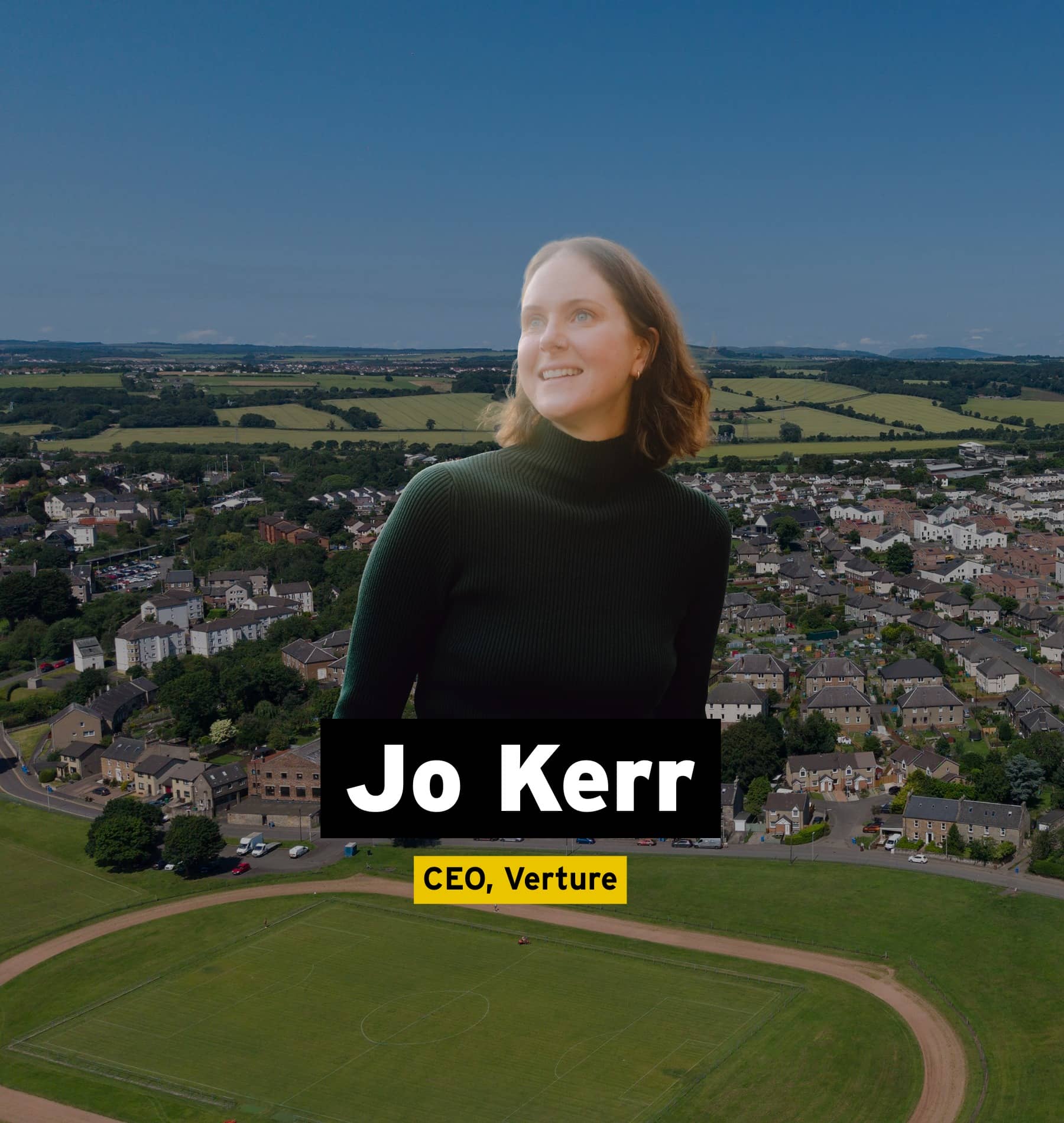
Jo Kerr, CEO of Verture, the climate resilience charity. Jo is passionate about climate justice and community climate resilience. At Verture, she focuses on strategic alignment, engagement, income generation, and culture. Before joining Verture in 2024, Jo was a director at Turn2us, working on financial insecurity, and a trustee of 360Giving. She is a fellow of the Intersticia Foundation. This year, Jo was a finalist for the Third Sector Awards (Rising CEO) and was shortlisted for the Charity Times Awards (Rising Leader).
Verture is the only UK charity focused on climate resilience as its core purpose. Verture exists to help create a fairer and safer environment for people to make their lives better now and to prevent future generations from suffering avoidable climate impacts. They work at local, regional, and national levels so learning doesn't stay in one place, connecting community experience, evidence, and the larger systems that make decisions.
Listen again or catch up on recent episodes...
We're committed to tackling the biggest climate resilience questions - and we'd love to hear from you. Whether you'd like to join us as a guest, suggest a topic or simply share your feedback, click here to contact us.
 Read more

