New GOV.UK handbook on Nature-based Solutions for Water Resources launches
Following a multi-year collaboration with the Environment Agency and a broad stakeholder working group, we are pleased to announce the official publication of the new Nature-based Solutions (NbS) for Water Resources Handbook on GOV.UK. JBA authored this new handbook, which builds on our work on the government’s Working with Natural Processes evidence base.

For twenty years, JBA has been at the forefront of working with Natural Processes and NbS. However, while the evidence base underpinning Natural Flood Management has been in development for a decade, quantifying the benefits of NbS for Water Resources (NbS4WR) has not been a focus.
The new handbook bridges this gap. It provides a comprehensive, structured framework for water companies, regional planning groups, environmental managers, and landowners to identify, screen, and deploy NbS to increase groundwater resources and improve river low flows.
The toolkit
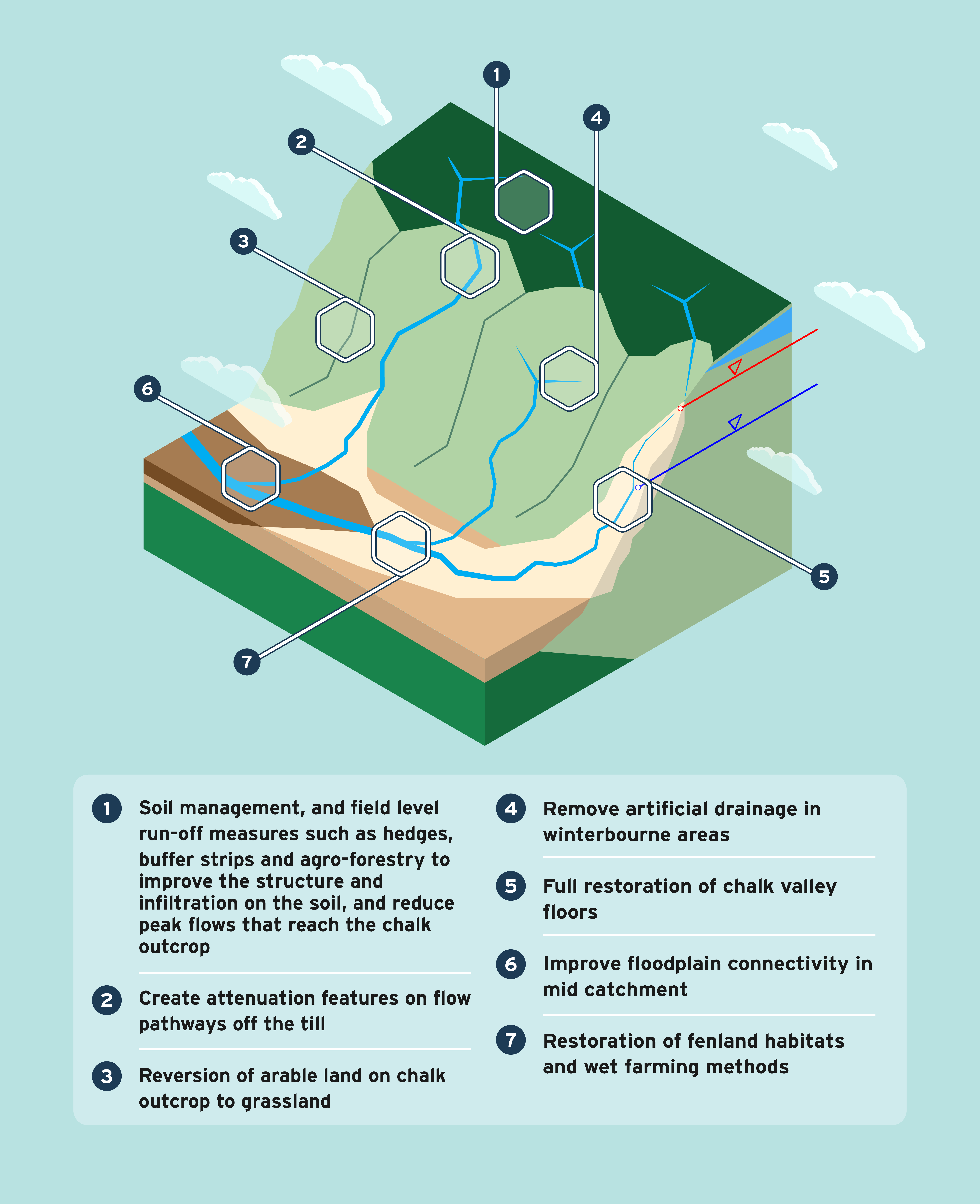
NbS4WR typically has the greatest impact when focused on the shallow groundwater components of the water cycle. There are four types of interventions within this zone, which can improve groundwater resources and low river flows:
- Water Usage: changes to land uses that reduce irrigation demands or lower evapotranspirational losses
- Runoff Infiltration Split: reducing rapid runoff and moving water into slower pathways through the soil and underlying geology
- Runoff Capture and Infiltration: slowing runoff that is generated and allowing it to infiltrate into the ground
- Floodplain and River Restoration: modifying floodplains to store more water and restore rivers to be more resilient to low-flow periods
Developing the evidence
A challenge to the wider adoption of NbS4WR will be quantifying the benefits. To justify investment within regulatory frameworks such as WINEP (Water Industry National Environment Program) and AMP8, decision-makers require robust, evidence-based predictions of what these naturalised systems can deliver. The new handbook addresses this challenge through an extensive literature review and by illustrating how regional groundwater modelling can quantify the impacts of implementation at scale. On the latter, the handbook provides case studies of our MODFLOW modelling for the Environment Agency and Water Resources East, available on the Water Resources East website.

You can access the full handbook for NBS for Water Resources on the gov.uk portal.
The future of NbS4WR: Meeting the Environment Agency's operational expectations
The Environment Agency’s position statement establishes a definitive expectation for water companies, regional planning groups, and major landowners to incorporate NbS into their planning, emphasising that appropriately designed NbS4WR must now feature in forthcoming Water Resource Management Plans (WRMPs), regional frameworks, and future Environmental Land Management (ELM) schemes. By integrating these landscape measures alongside other resource options, water companies can increase operational and environmental resilience to climate change.

To find out more about how JBA can assist your organisation in integrating NbS into your long-term water resource and environmental destination planning.
 Read more

